
THE CENTRAL DOGMA OF MOLECULAR BIOLOGY
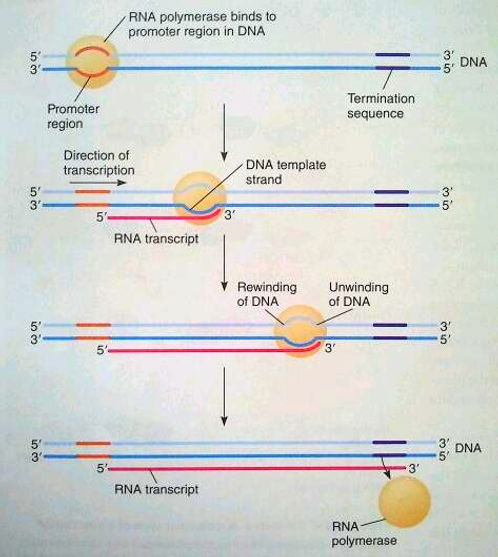
Transcription
An overview of transcription:
Once RNA polymerase has recognize the correct promoter, it unwinds the DNA double helix and initiates transcription. Unlike DNA synthesis, RNA synthesis does not require a primer. However, transcription requires several proteins in addition to RNA polymerase.
The first nucleotides at the 5' end of a new mRNA chain initially retains its triphosphate group. However, during the elongation stage of transcription, as each additional nucleotide is incorporated at the 3' end of the growing RNA molecule, two of its phosphates are removed in an exergonic reaction that leaves the remaining phosphate to become part of the sugar-phosphate backbone (as in DNA replication). The last nucleotide to be incorporated has an exposed 3'-hydroxyl group.
Elongation of RNA continues until termination, when RNA polymerase recognizes a termination sequence consisting of a specific sequence of bases in the DNA template. This signal leads to a separation of RNA polymerase from the template DNA and the newly synthesized RNA.
Watch this video for more info:
The actual formation of gene product requires RNA; the production of RNA on the DNA template is called transcription.